[credit: matthijs rouw]
I want to talk about DJ gain control today. Because it’s really out of control.
As DJ’s, we’ve spent hours, weeks and years honing the various aspects of our craft: mixing, scratching, blending, programming a set, reading a room, digging for new sounds, mastering various types of equipment, learning about different genres of music…
But truthfully, most of us fail at monitoring and maintaining optimal sound levels. It’s the one aspect of the craft that has been completely abandoned and I’m aggravated about it.
If you’re not wearing earplugs at any show or nightclub these days, you’re in for a brutal assault. A few years ago, I started leaving a set of earplugs in every bag that I use. My regular day bag, my dj bag(s), travel bags. With the type of schedule I keep, I never know when I might end up at a party, a show or a session, and I ALWAYS have to be prepared with plugs.
With most DJ’s these days, if you take a look at their mixer at peak time, the meters are slammed in the red, their gain knobs are maxed and their master volume knob might be topped out too.
Red means “Turn the volume down, you asshole!”
If there isn’t any dynamic processing in the signal chain, at best the music will sound horribly distorted. If there are compressors and limiters and they aren’t set right and/or you’re pushing them too hard, you’ll get that irksome pumping sound. At worst you’ll blow a speaker or two, or all.
Then you have people on the dance floor looking like this:
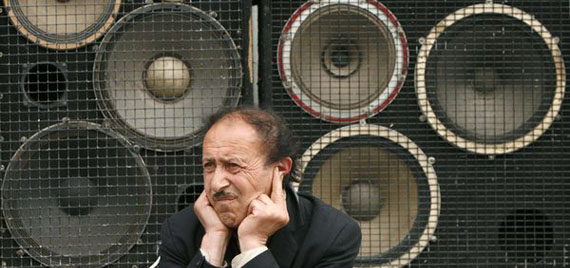
These people are not enjoying themselves.
Understandably, many sound systems are poorly set up and maintained. They make it difficult to pump the music so people feel it in their chests and asses, but aren’t being assaulted. Note that I said “difficult” not “impossible”. Our own judgement and attention to detail are the best tools for creating an optimal experience for the folks on our dance floors.
– EQ your tracks as you play them.
Cut those shrieking mids or that rumbling sub-bass. You’ll often find that perceived loudness increases with clarity as opposed to simply cranking it up.
– Start your set with optimal gain levels.
This might seem so basic but it’s so misunderstood. Unity gain is generally marked on most volume controls as the 0 (zero) level. That means that the signal coming into the channel is the same level as the signal going out. YOUR JOB IS TO MAINTAIN UNITY GAIN ALL NIGHT. You should set your master and the front end processing (if you can access those controls) to allow you some headroom over the course of the night, but you should NOT use your individual channel gains for overall volume control. I use channel gains to get an approximate pre-fader output balance before I even mix anything with the crossfader or line faders.
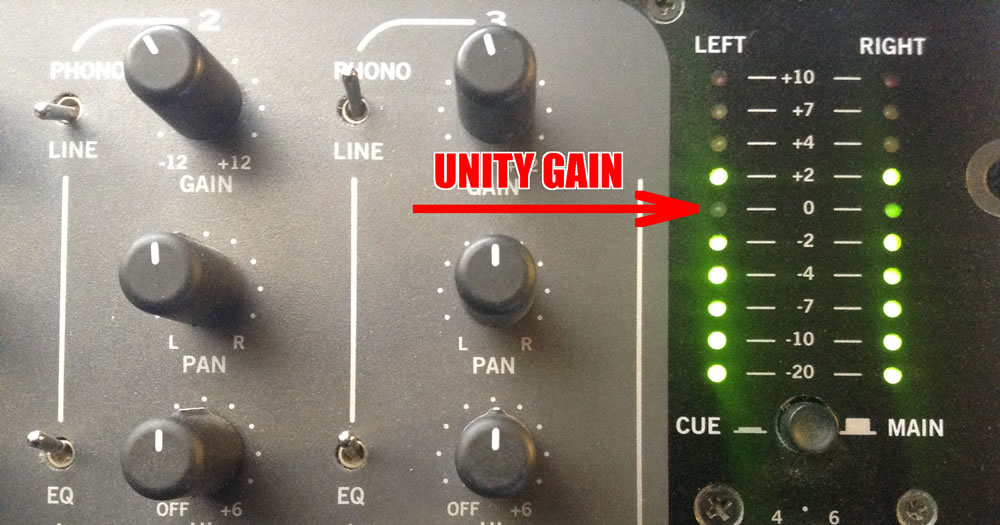
Gain creep is a fact of life for the DJ. Over the course of a gig, the amount of distractions grows, the energy in the room increases, the noise floor increases as more people pack into the space, and one must compensate. But rarely is this done with any sort of specificity. For far too many DJ’s, louder is always better.
– Walk the room.
I regularly leave the turntables to assess the volume levels. Some folks find this odd. (“What are you doing out of the dj booth?!?”) If it’s a room I’ve never played before, I do this a lot. Few of us have the opportunity to always play clubs with optimal DJ booth monitoring, so it’s almost a given that the sound in the booth will differ drastically from the sound on the floor. YOU MUST ALWAYS BE AWARE OF WHAT YOUR DANCE FLOOR SOUNDS LIKE.
Please, all of you. You’re killing folks out there. People going home from parties with migraines and ringing ears. Sound systems being blown. Records sounding like crap because of distortion. The DJ gain control problem ranges from the amateurs up to the pros. We all want our parties to crank, but ultimately Bob Marley knew the way things should be:
“One good thing about music, when it hits you feel no pain.” (Trenchtown Rock)
For more on DJ gain control:
- Gain Structure for DJs 101 (Serato)
- DJ Essentials – Trust The Levels (DJ Tech Tools)
- Getting The Volume Right: A Practical Guide For DJs (Digital DJ Tips)
Responded to this on DS, but want to put it here as well:
Rhome,
Great points.
Let me add my two cents as well:
I think you should have mentioned how leaving alot of headroom can not only prevent the floor from going deaf, but is a tactic that can be worked to your advantage. Francois K. and Danny Tenaglia especially are experts at utilizing volume to peak the crowd and emphasize the best part of the songs.
The shelter dudes (timmy regisford and sting international) were also real masters at this, keeping the volume lower and the bass subdued a bit for long extended periods of time then when the right moment would come to build the energy even greater, pump both of these up to literally lift a room off its feet.
The human ear naturally perceives louder to be better, however how many DJs do you know that actually turn the monitors off or low when they aren’t in the mix?
I have been fortunate in the past year to have played some great spots with great sound systems. In every situation I have had veterans helping me and showing me pointers along the way. I think alot of folks could benefit by taking a bus ride up to NYC or Baltimore and watching some of the veterans and legends put these principles to practice.
Chris,
I didn’t have to mention your points because you did it expertly. I wanted to create a dialogue so your input is right on time. Hopefully more folks will have helpful thoughts to add.
I particularly identify with playing with the monitors off. I do this all the time because I’m listening to the room. Very important.
And you know I was taking mad mental notes when Timmy was at T&T.
Dynamics are a great tool to generate more emotional energy in your sets, but you can’t have dynamics if you’ve pumped everything so loud that you have nowhere to go!
Well what can you say? there are a lotta novice wanna be dj’s out there. but who is the bigger douche? the novice who cant keep his knobs at a proper level or the dumbass who booked him/her? If you are going to let somebody play with thousands of dollars worth of equiptment, make sure they know what they are doing.
It is also nice to be able to hear the person you are talking with at club/party. I’m not saying I prefer music as background noise, but I am saying it isn’t always the song that needs cranking. Unfortunately, there are plenty of dj’s that think a song wont suck if they blast it.
I often get told to turn it up cuz green is keen and yellow is my fellow on the level readout(cheezy but true). To those knob riders; if you are gonna go red and clip all night, be aware I will probably start a fight with you and your whole army of dumbasses who can’t dj with professionalism.
Well I think that’s my 2 cents. don’t spend it all in the same place. EZ
[…] of one of my favorite DJs – DJ Stylus: djs stop playing so fing loud I want to talk about gain control today. Because it’s really out of […]
its not just novice djs who don’t know how to control their level, a lot of cats who are on a pro level and should know better don’t.
and on another note.
THIS HAS BECOME A BIGGER PROBLEM THANKS TO LAPTOP DJS
at clipped gains, mp3s sound like shit. and theres a lot of TOYS out there who dont know how to work a mix.
seriously DJs NEED SOUND LESSONS.
I think spinning for many years on horrible sound systems, or speakers that are old as piss, amps dustier than grandma’s attic, or the most favorite combination of the three has taught me to take it easy on the gain- otherwise the party sounds like garbage. Even though when spinning at venues with old, crappy sound (im talking COMMUNITY speakers people, come ON!) im a bit jealous of the glitzy nightclub sound, but it just means that I cant crank it all night, and I can only save my volume jacking for the height of the party. lol. and trust me, I love my bass as much as the next DJ- my wife says she can hear my car from two blocks away sometimes, she has called my whip “the ghetto blaster” LMAO!! but I dont bring that to the club!
For the new jacks, spinning at a venue with cruddy sound will teach you to control your levels, and then when you hit the big-time sound systems, your shit will sound HOT! for the new jacks who are transitioning without filtering or bass-cuts, if you EVER tried that shit on a crappier system, you would clip (or blow) your subs in no time!
holla!
ok
so last night i was in a club and it was rediculous how loud it was. this shit has got to stop. the club i was in had a bus front clip in the club. this means they found a bus and chopped the front clip off and the dj sits in the bus and you can see him through the front window. well it seems he is protected but the other people listening were wasted and so they really have no idea what kind of ear damage is being done. i think there should be laws which protect consumers from this kind of loud music. they should have someone from the city going into the clubs like a secret shopper. then he pulls out an SPL meter and if the music is at a certain point like over 105 db,then the club gets fined. 3 times and then the club gets shut down. that’s the only way it’s gonna have to happen. it’s just out of control…and no one cares except people who are educated about it.
Great post, as usual. So true. And yes…headroom, headroom, headroom.
I can why you like this photo so much:
“Did U know That RED lights make U a Shit DJ?”
http://nobreastsnorequests.tumblr.com/post/5867121971/yes-submitted-by-scratchabit